Exactly a fortnight ahead of the Reserve Bank of India's (RBI's) next monetary policy review, a key market indicator of interest rates - the overnight indexed swap (OIS) - suggests that the central bank may tighten policy by 35 basis points and then refrain from further rate hikes. RBI Deputy Governor Michael Patra recently described the OIS as the primary instrument for hedging interest rate risk in India. The six-member Monetary Policy Committee (MPC) of the RBI will meet on December 5-7.


Ask rediffGURU Naveenn Kummar your insurance mutual fund and personal finance-related questions.

'The real repo rate is very high in terms of core inflation.'

The Reserve Bank of India on Friday decided to keep benchmark interest rate unchanged at 4 per cent but maintained an accommodative stance even as the economy is showing signs of recovery after the second Covid wave.

Pressure has been mounting on the Reserve Bank of India to cut interest rates in the wake of declining retail inflation and the need to fuel growth momentum. However, the RBI will have to do a tightrope walk as globally interest rates are inching upwards.
The 30-share Sensex ended lower by 61 points at 29,122 mark and the 50-share Nifty slipped by 12 points to close at 8,797.
A day after the RBI raised the benchmark lending rate by 35 basis points, Kotak Mahindra Bank Managing Director Uday Kotak on Thursday said the central bank may go for one more rate hike to bring inflation below its upper tolerance level of 6 per cent. Yesterday, the RBI indicated that it wants inflation to be within the band first and then move towards the target of 4 per cent, Kotak said at the CII Global Economic Policy Summit 2022. "My sense is that there could be one more rate hike and that may be the time for thinking about a pivot, but we got to watch very closely the data, and maybe around 6.5 per cent as it looks today, subject to what happens to the world, subject to what happens to oil, subject to what happens to many other things," he said.

The Reserve Bank will go for a "dovish pause" at Wednesday's policy review announcement amid developments such as a rise in inflation, government maintaining the inflation target band and a likely impact on growth due to local lockdowns on rising COVID-19 infections, analysts said on Monday. Economists at American brokerage Bofa Securities said price stability, growth and financial stability will become the prime focus areas for the central bank going forward. "The RBI MPC (Monetary Policy Committee) should deliver another dovish pause on Wednesday," it said. The policy announcement, the first for the fiscal, will come days after the government maintained the RBI's target to ensure inflation to be within 2-6 per cent band for five more years.

Trading sentiment in the equity market this week will be guided by global trends, foreign fund movement, macroeconomic data announcements and RBI's interest rate decision, analysts said. The monthly auto sales data announcement would also be tracked by investors this week.
Since January 1, the rupee value has fallen by 5.5 per cent against the US dollar and touched life-time low of 58.98 on Tuesday.

The Reserve Bank's of India's (RBI's) decision to increase the key short-term interest rates by 25 basis points has been termed as in-line with the street expectations by marketmen.

Wholesale price inflation dropped to 0.85 per cent in April as prices of food articles, manufactured products, and fuel eased, government data showed on Wednesday. WPI-based inflation was 2.05 per cent in March. It was 1.19 per cent in April last year.

'Do exhaustive research and then select the one that best fits your budget and requirements.'


RBI's previous monetary policy was announced on September 29.

The finance ministry wants the Reserve Bank of India (RBI) to switch its policy stance, with growth concerns occupying centre stage and inflation showing signs of moderating.
Lending rates have to be sensitive to the policy rate, says RBI.

The move would also help banks garner more funds to meet their lending needs.

'Banks are being encouraged to lend instead of parking their resources with the RBI and earn risk-free interest income,' points out Tamal Bandyopadhyay.
The Reserve Bank of India on Wednesday said banks' response to monetary actions in terms of cutting interest rates have been mute and there is room for further softening of interest rates.

The wide-based National Stock Exchange index Nifty also traded marginally up.

Governor Raghuram Rajan lowered the benchmark repurchase rate to 7.75 per cent from 8 per cent, the first reduction since May 2013.
RBI in wait and watch mode as several risks to inflation continue to exist including a sudden reversal of food prices and oil price volatility.

There is a strong case for 25 basis points cut in interest rates.
The broader 50-issue NSE Nifty too slipped from its record high, shedding 10.30 points or 0.09 per cent to end at 11,346.20.
The Reserve Bank of India's rate-setting panel will go for a 0.35 per cent hike in the key repo rate at its meeting next week, an American brokerage said on Wednesday. The hike will be accompanied by a change in the policy stance to "calibrated tightening", Bofa Securities said in a report published ahead of the Monetary Policy Committee (MPC) resolution which is set to be announced on August 5. RBI has hiked the rate by a cumulative 0.90 per cent in two tightening moves in May and June, responding to the runaway headline inflation which has consistently overshot the upper end of the target set for the central bank for many months.

The Urjit Patel committee on monetary policy framework has proposed setting up of a monetary policy committee (MPC) that will be headed by the Reserve Bank of India (RBI) governor and accountable for achieving inflation target set by it.

Private sector banks slipped in market capitalisation (mcap) during the July-September quarter, underperforming their government-owned peers as trade uncertainties dragged market sentiment, said S&P Global Market Intelligence. According to its analysis, HDFC Bank shed 4.8 per cent in mcap during the third quarter, while ICICI Bank's dropped 6.7 per cent.
An Assocham survey has predicted interest rate cuts by RBI following fears of recession and slowdown in industrial growth.

S&P Global Ratings on Tuesday cut India's GDP growth projections to 6.5 per cent for the next fiscal as it expects that economies in the APAC region will feel the strain of rising US tariffs and pushback on globalisation. In its Economic Outlook for Asia-Pacific (APAC), S&P said despite these external strains, it expects domestic demand momentum to remain solid in most emerging-market economies.

India's GDP for the three-month period ended September 30 grew 7.4%.

Wholesale price inflation moderated to 2.31 per cent in January due to the decline in prices of food items especially vegetables, government data released on Friday showed. The Wholesale Price Index (WPI) based inflation was 2.37 per cent in December 2024. It was 0.33 per cent in January 2024.

It believes that RBI will continue with liquidity infusion through CRR cuts and open market operations. Rate cut may happen only in January

Experts said a future rate cut would depend on the inflation.
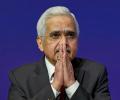
Outgoing Reserve Bank Governor Shaktikanta Das said on Tuesday that restoring inflation-growth balance is the most important task ahead of the central bank. Addressing a press conference on his last day as the central bank chief, Das said his successor will have to navigate the changing world order, effectively deal with cyber threats, and focus on harnessing new technologies.

These are the highlights of the seventh bi-monthly monetary policy statement for 2019-20 by the RBI amid COVID-19 pandemic:

The RBI, which has been keeping rates at an elevated level citing high inflation, wants it to come down to 6 per cent by January 2016.
To stamp on inflation, RBI raised its key short-term lending and borrowing rates by 0.25 per cent and 0.50 per cent respectively.

'There are occasions when the prices of individual items like food raise inflation; then supply-side measures must be taken.' 'But if there is continued inflation, it means liquidity is aggravating the situation.'
